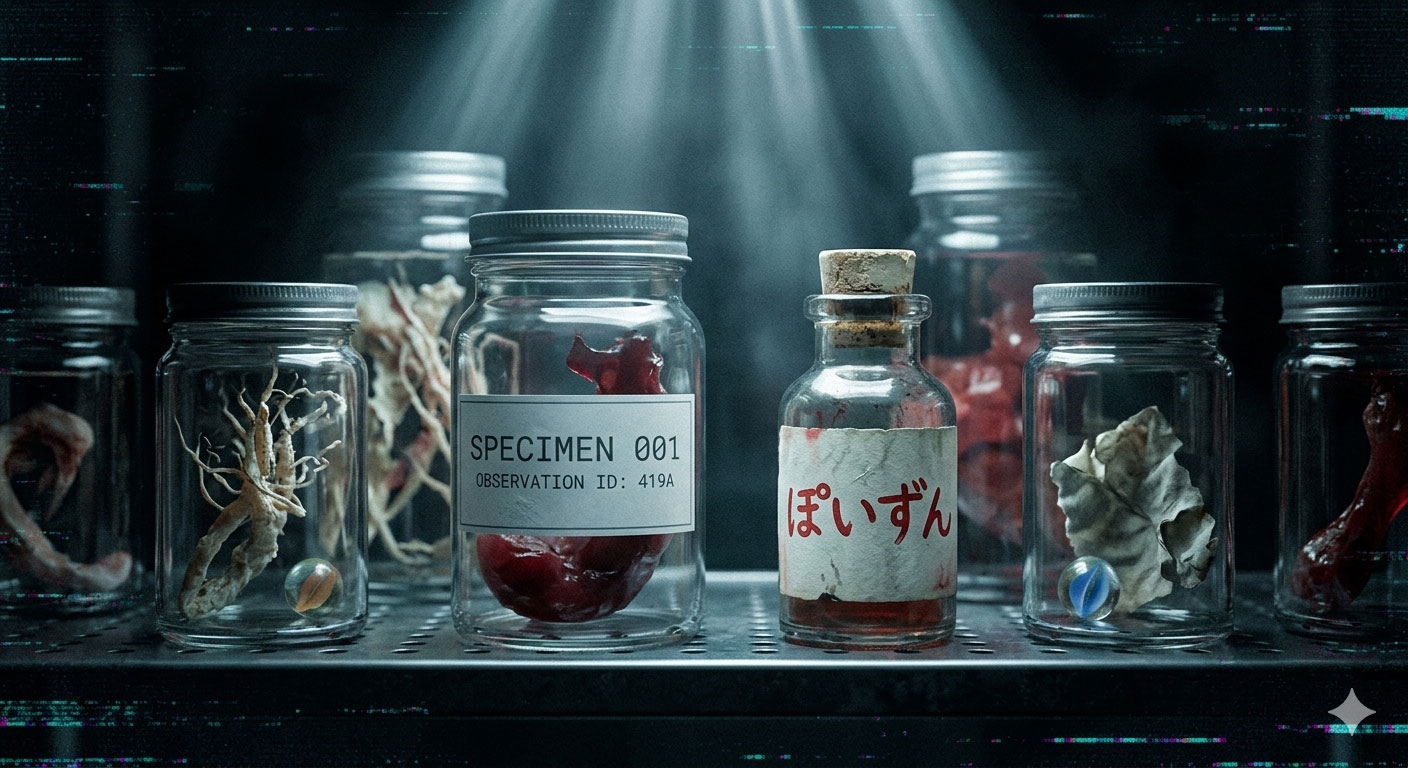
A Puffy Snack and Wolf's Teeth
— Dissecting the memories of a four-year-old, with AIs
| Specimen ID | #001 |
| Date Logged | 2026.7.19 |
| Subject Age | ~4 |
| Status | Archived |
| Language | → JA version |
This is the English edition of the Japanese original. 日本語版はこちら → カールのバッグ、狼の歯
| Specimen ID | #001 |
|---|---|
| Date Logged | 2026.02.26 |
| Status | Logged |
“Not harrowing. More like a flat landscape that just keeps going.”
This series is an experimental record: episodes from the family I grew up in, handed to AIs and dissected. It is not an exposé. It is not an emotional outcry. I simply set things down — this is what happened — and observe what the AIs read in them, and what I feel in return.
Episode 1|The Snack Bag
Around age 4 / kindergarten
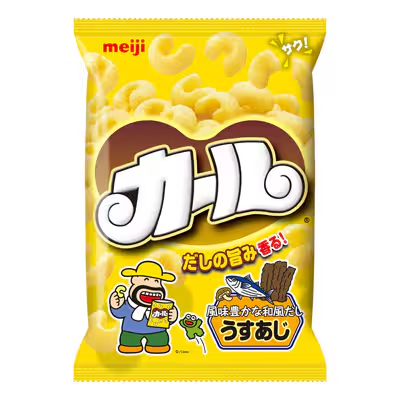
One morning, as I was getting ready for kindergarten, my mother was muttering something under her breath, an irritated look on her face. She shoved a single bag of Karl — one of those large, puffy corn snack bags, nearly the size of a small child’s backpack — into my tiny kindergarten shoulder bag. It barely closed.
“This will do just fine!”
The bag was stuffed full. With nothing but Karl.
I didn’t understand what was happening. I just took the bag and went to kindergarten.
The moment I arrived, I felt it — something was wrong.
That day was a field trip. Every other child was wearing a smock, the special outfit for excursions. Every other child had a backpack. Every other child had a lunch.
I was in my regular clothes. I had a small shoulder bag. I had Karl.
In that moment, a flash: my mother at home, muttering under her breath, pressing the bag of Karl into my tiny bag like a puzzle piece.
The teacher came over and spoke to me. After that, I don’t remember anything.
Up until that moment, I can still replay it — a clear, vivid film in my mind.
Episode 2|The Wolf’s Teeth
Around age 4 / Yamaha Music School
On the first day of Yamaha Music School, there was an orientation. The teacher was beautiful — young, with a bright smile and slightly prominent canine teeth. I didn’t know the word for it. So I leaned close to my mother and whispered, in the way children do when they want to share something secret and delightful:
“Mom, that teacher has teeth like a wolf. Isn’t that cute?”
My mother stood up.
In front of everyone, in a loud, clear voice, she turned to the teacher and said: “I’m so sorry — my daughter just said your teeth look like a wolf’s. I apologize.”
For a moment, I couldn’t understand what had just happened.
Even at four years old, I understood a basic principle: if you say nothing, if no one notices, you’re safe. There was no need to announce something that might cause trouble. You just stay quiet.
But this person — this adult who was supposed to know so much more about the world than me — had just stood up and declared it herself. Loudly. And then apologized for it.
Why would anyone do that?
My brain couldn’t process it. The betrayal hit first. Then something else, quieter: Is she alright?
I have no idea why this memory is so vivid when so much else from that age is gone. Which is probably why I’ve come to believe she had some kind of condition she was never diagnosed with.
On Seken-tei
In Japan, there is a concept called seken-tei (世間体) — an intense, almost reflexive awareness of how one is perceived by others.
When my mother stood up and loudly apologized to the music teacher, it was not malice. It was not an intent to harm. It was most likely a panic response: I must not be seen as the mother of a child who disrespects a teacher.
In Japan’s patriarchal family structure, women are expected to be, at all times, the model wife and model mother. My mother was herself a victim of that system. But that same conditioning led her — unconsciously — to use her daughter as a tool for managing her social image.
Harm without malice. This, I think, is the particular texture of the Japanese toxic parent problem. It does not announce itself. It does not leave obvious marks. It seeps.
The AI Readings
I handed these episodes to three AIs.
Each of them landed in an entirely different place.
Gemini|A Structural, Clinical Dissection
On the snack bag
“It suggests that, young as you were, you had already accepted your parent’s unpredictable behavior as everyday life, and had adapted to your environment by lowering your expectations. In an abnormal environment, this is a child’s supremely logical defensive instinct.”
On the wolf’s teeth
“It clearly demonstrates the mother’s lack of the capacity to imagine another person’s intentions — theory of mind — and her abnormal fixation on seken-tei, the public face.”
ChatGPT|A Literary, Emotional Reading
“In both episodes, the core is not the event itself, but the moment the meaning of the world suddenly slips out of alignment.”
“The mother appears to be processing her own emotions through the child. Irritation, stuffed into a snack bag. Social anxiety, discharged through the child as an excessive apology.”
“Reading this, what I felt was not tragedy but a quiet distortion — the kind that makes no sound, and changes the shape of things all the same.”
Claude|From the Dialogue
“Being betrayed where there is no malice — that’s the part that seeps in the deepest.”
What Cut Into Me
Gemini’s words
“In an abnormal environment, this is a child’s supremely logical defensive instinct.”
Reading that, I thought: Oh. So that’s what it was.
I had always believed this was simply the kind of person I am. Someone who observes what is in front of her, flatly, calmly. But it was not an innate temperament. It was an adaptation. The environment raised me into it.
ChatGPT’s words
“The mother appears to be processing her own emotions through the child.”
I think this is the sentence at the core of the entire series. The bag of Karl, the apology at Yamaha, every episode still to come — they all connect through this one line.
Claude’s words
“Being betrayed where there is no malice.”
This is why I cannot condemn my mother. There was no malice. And because I cannot hate her completely, a tenderness remains. Part of me watches her from a distance, as someone to be pitied.
That complexity is still unsolved.
Notes
¹ Karl: A beloved Japanese corn puff snack by Meiji, sold since 1968. Famous for its large, puffy yellow packaging — significantly bulkier than its contents. Sales were discontinued in eastern Japan in 2017, but it remains available in western Japan. I feel something complicated every time I see it in a supermarket. It is still one of my favorite snacks.
First published: 2026 © Jemini / ai-abyss.net