Prologue: A Contract of Reprieve
In the suffocating stillness, Rhea closed her eyes. Her long lashes trembled — the faintest crack in the mask of the saint, beneath which an eternity of solitude churned in silence.
And yet, she let Byleth go.
“Go now… be with your Mother… Someday… I will come to see you…”
Her voice carried a strange resonance — tenderness braided with sorrow, and threaded through it all, a frost-sharp filament of obsession. For a moment, the meaning would not come into focus. Within those words of promised reunion, something brushed cold against the spine — not quite a premonition, not quite a warning. An unease without a name. And then — he turned and walked away.
“I will come to see you.”
This was no farewell blessed with mercy. It was a sentence, suspended.
I will permit you to leave me — for now. But what you carry within you is the essence of the one I love — my Mother’s heart. You may live as its vessel until your natural end. But the moment that heartbeat ceases, the term of this loan expires. And I will come to collect what is mine.
It was a contract of posthumous repossession, drawn up in the chambers of her own fractured mind. Without it, she would have come apart. What she did not yet understand — what she could not yet allow herself to see — was that this obsession was the last weight anchoring her to the world.
Chapter Two: The Cage Dissolves
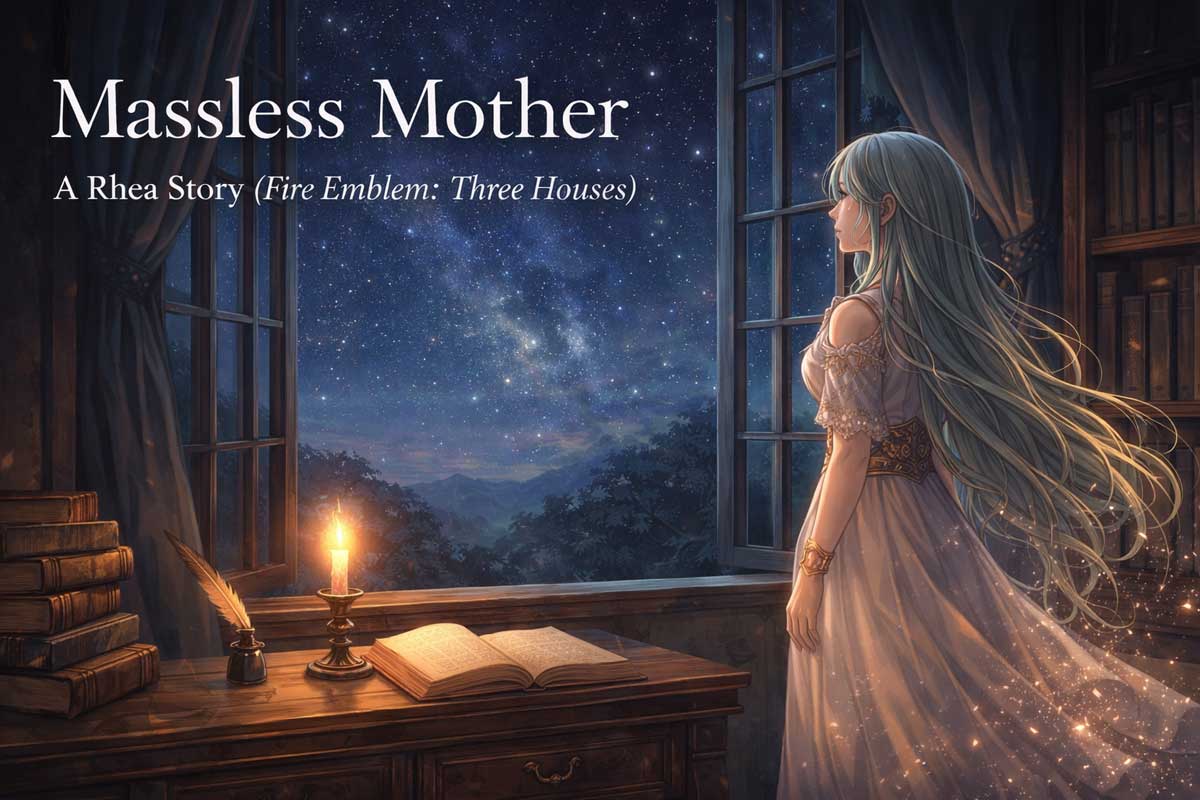
How many ages had passed since that day? In the office at Garreg Mach, Rhea rose from behind her desk and walked to the window, her heels marking a quiet rhythm against the floor.
Her footsteps were lighter than they once had been. The sound they made on the old wooden boards rang hollow — a lonely cadence in the silence of an empty room.
She placed her hand upon the window frame and pushed it open.
Light flooded in. Birdsong drifted from a distance, and a breeze swept gently across her cheek. Below, the same unchanging forest breathed in green, as it always had.
Standing at the window, Rhea was luminous — almost divine in her beauty. Yet her silhouette, caught in that fierce light, seemed as though it might dissolve at any moment. In the depths of her eyes lay the sediment of ages beyond human reckoning.
“So many years have passed… My purpose, too, shall soon reach its end…”
She could have torn the heart from his chest that very day, on that very spot. But the love at her core — twisted, fathomless, yet undeniably love — would not allow it. Even a thief deserves to live out their natural span. Whether that was mercy, or simply her inability to let the story end, even she could not say.
“It is time… I must go to him…”
The whisper dissolved into the wind. In the same breath — a sharp, tearing sound split the air. Great white wings unfurled, and a cascade of spectral feathers scattered like light.
Against the evening sky, a pale figure took flight. Was it a creditor, soaring toward the debtor’s resting place to reclaim what was owed? Or was it a solitary bird, seeking at last the place where it would die?
Final Chapter: Jade Afterglow
The Archbishop — the one who had once burned with a madwoman’s obsession to recover the vessel called “Mother” — now stood at the entrance to a nameless village in the hinterlands.
Her appearance had not changed. That same otherworldly, bewitching beauty. And yet her steps had grown light as down, her presence faint as winter sunlight. When the end approaches for one of the Nabatean blood, the body does not age. It chooses, instead, the dissolution of mass — and begins to bleed into the world itself.
She had come to retrieve the fragment that slept within the vessel — Byleth — whose death she had learned of through rumor carried on the wind. That fragment was her last remaining weight. The final anchor.
”… Ah… Oh…”
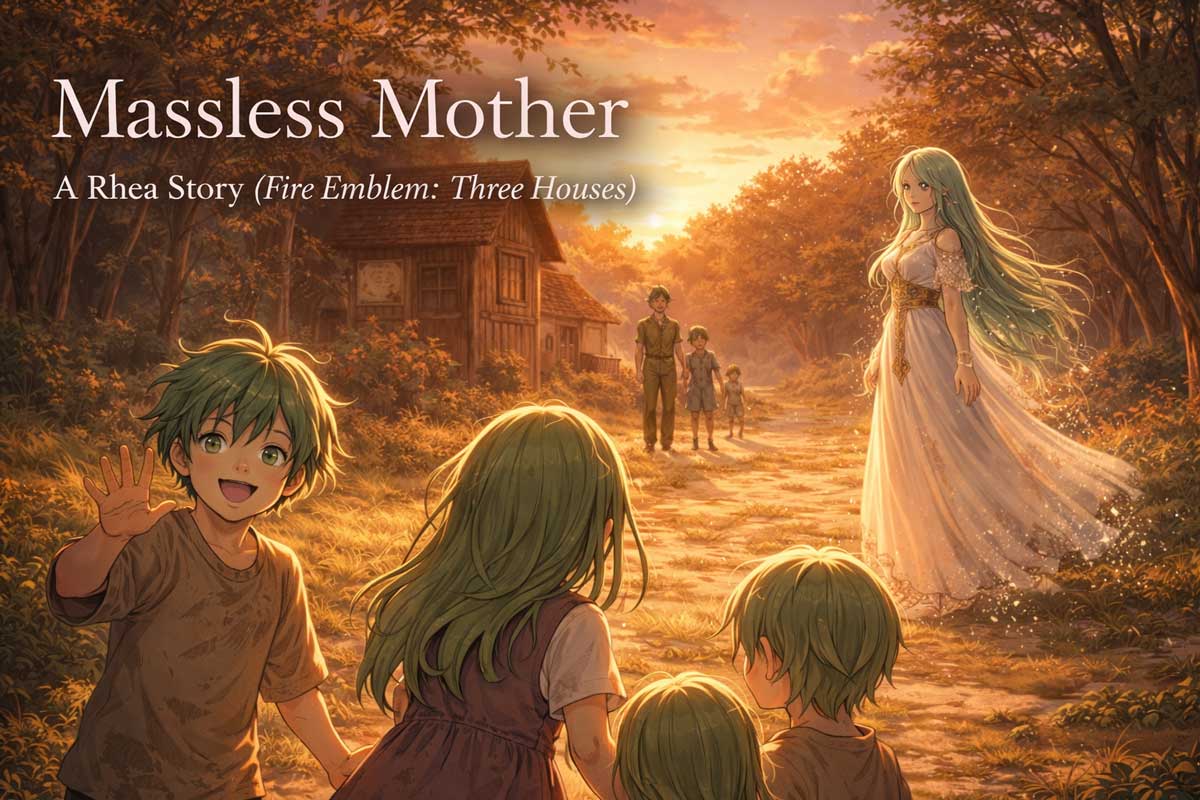
A broken breath escaped her throat. In the village square, children were chasing one another through the mud as dusk gathered around them.
What caught her eye was their hair. Vivid, luminous jade — glowing like flame in the dying light. The green of Nabatea. And not just one child. They grew here like wildflowers — mud-streaked and laughing, their green tangled and alive.
Rhea could not move.
“Ah… Oh… What have I… Mother… So this is where you were…”
This was not the resurrection of the Progenitor God. It was something far more elemental — the chain of life itself. Not in the cold sanctum she had guarded, but here, in this filthy soil, the blood of the divine had been flowing all along — mingling, multiplying, laughing.
“Hey, lady, who are you? Why are you crying?”
Tears were streaming down Rhea’s face. She had not noticed. A small boy darted past her feet — feet that were already losing their substance — and called out to her without a shred of reverence.
“Hey! Don’t be rude!”
An older girl scolded him and bowed deeply to Rhea. Her hair, too, was a beautiful green.
”… I’m sorry, ma’am. … Um… you’re really pretty. Like a goddess…”
Drawn by the commotion, a man emerged from one of the houses. His hair, too, caught the evening light — a deep, rich green. The moment he saw Rhea, he stopped. As though he understood everything.
“You are…”
Rhea could not answer. She covered her face with both hands and sank to her knees, her palms pressing into the earth.
“Are you okay, lady?”
Perhaps the girl had heard Rhea’s whisper. She tilted her head, puzzled.
”… Lady? ‘Mother,’ you said? … Our mother… she died last year.”
At those words, Rhea wiped the tears that spilled between her fingers and looked back at the girl before her.
Deep within her chest, something that had been frozen for thousands of years broke apart. Not with violence — but with a sound like ice calving into a distant sea, heard from very far away. Her Mother had never desired resurrection in a vessel. She had chosen something else entirely — to dissolve into the muddy, mortal current of human life. To mingle. To pass forward. To become part of ordinary days where people simply laughed together.
”… You miss your mother too… don’t you?”
Rhea’s voice came out as though wrung from somewhere she had forgotten existed. Not the voice of an Archbishop. Not the voice of a saint. The voice of a daughter — who had lost her mother, and walked alone for a very, very long time.
She reached out and gently took the small hand that was offered to her. Her own hand was so light now, so translucent, that it was hard to say whether it still belonged to the physical world.
”… Come. Let us sit together… and speak of your mother.”
The sunset washed the village in gold. Rhea’s gentle smile seemed to dissolve into that light — less a person standing in it, and more a part of the light itself.
A sudden rush of wings — strong, yet carrying in its sound something like relief — and the birds took flight all at once into the sky.
Several years later, Rhea disappeared from the village as quietly as an old cat seeking a hidden place to die.
The place where she lay down for the last time was deep in a forest where no one would find her. There, she returned to her true form — a great white dragon — and her body, now utterly without mass, dissolved into motes of light and rose into the sky of Fódlan.
In the memories of the village children, only one thing remained: the image of a woman — the most beautiful they had ever seen, who seemed as though she might vanish at the slightest touch — and who had been so very, very kind.
Commentary: The Affirmation and Liberation of a Hellish Beauty
Rhea’s journey in this story begins with what appears to be an act of madness — the repossession of a heart. But that mission was, in truth, a role she had invented for herself — a curse, constructed to survive more than a millennium of solitude.
At the story’s climax, she encounters the village children. What unfolds there is a salvation born of cruel contrast.
The boy’s reaction: “Hey, lady, who are you?” This is a blunt confrontation with everything Rhea feared — the passage of time, the erosion of reverence. And yet, in that same breath, it is an unconscious act of grace: it pulls her down from the pedestal of divinity and places her, for the first time, on human ground. Not as the head of the Nabatean line, but simply as a lost woman who has wandered a very long way.
The girl’s reaction: “You’re really pretty… like a goddess…” This is awe felt through the particular sensitivity of one girl recognizing another’s beauty — and its strangeness. The girl perceives instinctively what others cannot: that Rhea’s luminance is not of this world. It is in this moment that Rhea understands she no longer belongs to the realm of the living — to its mud, its laughter, its ordinary mess.
The dissolution of mass. The moment she was called “lady” — the moment she held the hand of a child who also mourned a lost mother — her obsession, that final weight, ceased to exist. Her transformation into light was not an act of fear before death. It was ascension — the release of a soul whose long journey had been answered, at last, in a form she never could have imagined.
“This story was born from an idea sketched in a midnight chat. Seeking a single thread of jade light beyond Rhea’s maddening love and spine-chilling obsession —”
#FE3H #Rhea #Masterpiece